Article

China wants to change pilot ladder regulations


published on 3 May 2022 1878 -

Despite the current regulations describing the different types of pilotage transfers, there are still many non-compliant pilotage transfers today.

China has already submitted proposals to the IMO regarding changes to SOLAS, Chapter 23, and IMO A.1045(27) in early 2021.

At both MSC104 and MSC105 (which ended last week) there was no time to address this important issue. At MSC105, the intention was expressed to discuss this issue at the upcoming MSC106.

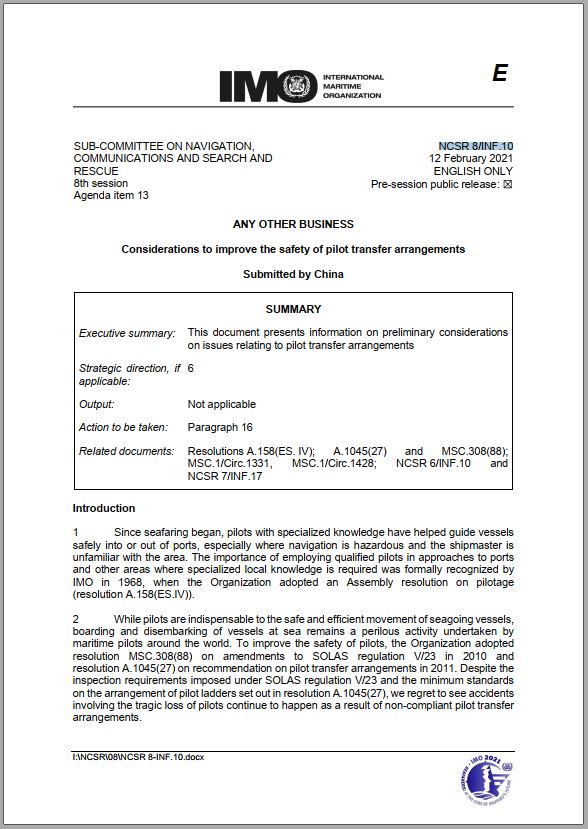
The attached PDF shows the proposal submitted by China to improve safety when transferring via pilot ladders.
The paper also discusses the so-called trapdoor arragements.

On LinkedIn these days, the internationally respected safety expert on pilot ladders, Capt. Arie Palmers assessed the submitted proposals as follows:
"Indeed it is better to take enough time to discuss this important and urgent matter. Not just the footnotes in SOLAS chV reg.23 and IMO A.1045(27) need to be amended; there is a lot more to change as you might know. Indeed a very good paper forwarded by China last year."
Click to download PDF


What's your opinion on this?
Login or register to write comments and join the discussion!
Read more...

Article Podcast: Maritime Pilot Safety and reducing the risk in pilot transfer operations

published on 4 July 2023

This is an in-depth discussion of the risks involved in maritime pilot transfers; an interesting job but with a risky commute to work.

0

Article Combinations Ladders: "1,000 combinations around" (by Arie Palmers)

by Arie Palmers, Netherlands - published on 13 July 2020

Before you, you see my third article on pilot boarding arrangements. After my two previous articles
(‘1000 ways to secure a pilot ladder’ and ‘1000 ladders around’, I have received a lot of feedback and
also questions to get deeper into the matter of combinations and embarkation platforms.

2

Article Murphy's law on pilot boarding - Arie Palmers

by Arie Palmers - published on 20 July 2021

"Anything that can go wrong will go wrong."

2

Article EMPA Newsletter issue 003

by EMPA - European Maritime Pilots' Association - published on 6 January 2022

The European Maritime Pilot´s Association has released the new Newsletter issue 003/2022.

2

Article AIMPA Journal- March 2021 issue IX

by AIMPA - All India Marine Pilots' Association - published on 19 March 2021

The All India Maritime Pilots' Association has released its new journal for March

0

Opinion Tugs: Big is Better? Article by Henk Hensen

by Henk Hensen - published on 19 September 2024

Tug power has increased considerably over recent decades. Today, some ship handling tugs have a bollard pull of more than 100 tons. In addition, high tug power can be installed in ever smaller compact hulls.

1

Video Maritime Simulation and Resource Centre. For Pilots. By Pilots

published on 13 July 2020

Specialized training for maritime pilots in Canada.
A LEADER IN TRAINING AND DEVELOPMENT
Founded in 2005, the Maritime Simulation and Resource Centre (MSRC) is a purpose-built marine pilot simulation training and turnkey port procedural development facility, offering unique navigational safety expertise in North America.

0

Article Rosmorport’s icebreakers completed over 2,400 pilotage operations

published on 20 January 2021

...in freezing seaports of Russia this season. In total, FSUE "Rosmorport" operates in 15 freezing seaports of the country.

0

Article Swift Action By UK Maritime Pilots Avoids Blocking Southampton Water

published on 31 January 2023

The United Kingdom Maritime Pilots Association (UKMPA), is the representative professional body for Maritime Pilots in the United Kingdom. Almost every ship entering or leaving a port, is required under UK law to engage a duly Authorised Maritime Pilot, who either boards the vessel in port or at sea and takes conduct of the safe navigation of that vessel. This undertaking is critical to protecting the country’s national infrastructure and environment from damage or pollution, supporting the UK’s economy, and ensuring the safe, timely and efficient movement of all trade.

1