Pictures from private archive Arie Palmers
Who pays when a pilot is injured on a ladder that should never have been rigged?
An opinion piece by Arie Palmers, maritime pilot, the Netherlands
Regarding pilot transfer arrangements — and basically everything that goes on on board — the captain is ultimately responsible. So the captain is also responsible for having a pilot ladder in good condition, as well as for the proper rigging of that ladder. At some pilot stations the question is asked before the pilot boards: “Can you confirm that the pilot transfer arrangement is compliant with international law and regulations?” It will not surprise you that the answer is always affirmative.
Pilots have the right and the duty to reject and report a non-compliant pilot transfer arrangement. The new and improved V/23 is quite clear on that in rule 12: “where a pilot or other personnel suspect the pilot transfer arrangement provided is non-compliant, they should inform the master and refuse to use the arrangement until it is made compliant.” In an ideal world the article could end here. After all: the vessel has to rig a compliant setup, and if not, the pilot politely declines and waits until things are sorted.
Pilots have the right and the duty to reject and report a non-compliant pilot transfer arrangement. The new and improved V/23 is quite clear on that in rule 12: “where a pilot or other personnel suspect the pilot transfer arrangement provided is non-compliant, they should inform the master and refuse to use the arrangement until it is made compliant.” In an ideal world the article could end here. After all: the vessel has to rig a compliant setup, and if not, the pilot politely declines and waits until things are sorted.
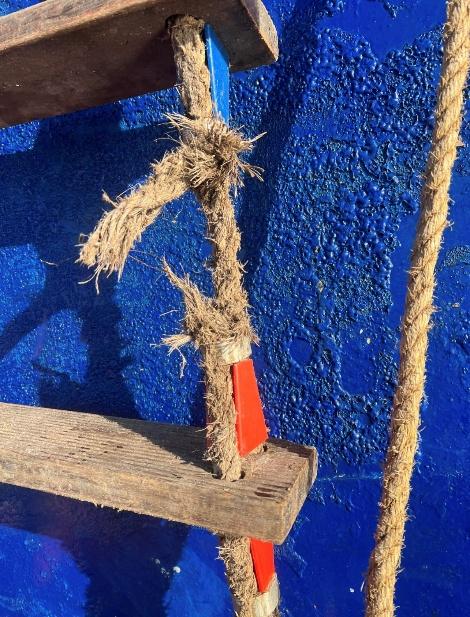
What made the crew think this was okay to rig?
What made the crew think this was okay to rig?
One could argue that the word “should” is a recommendation rather than a legal requirement. It is not. One of the most important changes arising from the amendments to SOLAS regulation V/23 is a mandatory safety regime for pilot transfer arrangements, including new performance standards for pilot transfer arrangements (IMO resolution MSC.576(110)). In many instances where “should” is used today, it is replaced with “shall”. SOLAS regulation V/23.12 is an exception to that, but it makes no difference to what is expected of pilots, or to the standard of professional care they are to exercise.
The first reason is that the word “should” is used because SOLAS can only impose obligations on States that have ratified the Convention. It cannot bind States to the actions of others, including pilots and other users of pilot transfer arrangements. The use of “should” does not mean that IMO regulation V/23.12 is a recommendation — it cannot be, as it is in an IMO Convention. The direct legal obligation on pilots will be reinforced by the transposition of SOLAS regulation V/23 into applicable national legislation.
The second reason is that what SOLAS says, or does not say, does not diminish the fact that a trained pilot, as an expert in the use of pilot transfer arrangements, is expected to recognise a non-compliant pilot transfer arrangement and to exercise professional care.
Unfortunately, the world is far from ideal. The results of the 2025 IMPA Safety Survey indicate a general level of non-compliance of around 14 per cent — one in seven pilot transfer arrangements. As you might know, after every workweek I publish “WEEKLY LADDER MISERY” on my social media, and my own experience is a non-compliance rate of well over 50 per cent. In my opinion this suggests that many pilots are not aware of what a compliant pilot transfer arrangement looks like; if they were, the IMPA results would be closer to my own experience.
We also know that a lot of pilots climb non-compliant setups all the time, and I thought it could be interesting to do some research on what would happen should a pilot get injured while using a non-compliant pilot transfer arrangement. For this research I didn’t need the library anymore; the internet is of great assistance.
As I stated above, the captain is primarily and ultimately responsible for having a compliant setup — especially when answering the question above in the affirmative. Using a non-compliant setup, however, can have some nasty implications for the pilot when all goes wrong. Since we know the pilot has the right and the duty to refuse and report a non-compliant setup, using it can lead to so-called contributory negligence: if a pilot’s own actions have contributed to them falling, financial compensation may be reduced according to their degree of fault.
Typically, insurance companies — or better and more correctly, Protection and Indemnity (P&I) clubs — would react with a “defence and investigation” stance, because the incident is a breach of international law (SOLAS V/23, IMO A.1045 and others). On the other hand, when the investigation shows that the vessel knowingly rigged a non-compliant setup, the insurer could argue gross negligence or wilful misconduct and deny the claim for the ship, which means the shipping company has to pay out of their own wallet.
These kinds of claims are very expensive, because the pilot might lose their income; ladder accidents are often career-ending or worse. Besides that, when a ship gets blacklisted, her normal running costs will definitely go up as well.
This is what normally happens: P&I clubs investigate and pay out. (For the record: P&I clubs are non-profit associations where both the insurer and the insured are members; pay to be paid.) Now we’re going to have a look at what happens when a pilot gets injured using a non-compliant arrangement. A pilot can never be solely liable in maritime law when they get hurt, but they can be held partially liable when they willingly used a non-compliant setup. On the one hand the vessel has the duty to rig a safe setup; on the other hand the pilot has the duty to take care of their own safety and not endanger themselves. And that makes perfect sense — why would you voluntarily endanger your life?
The first reason is that the word “should” is used because SOLAS can only impose obligations on States that have ratified the Convention. It cannot bind States to the actions of others, including pilots and other users of pilot transfer arrangements. The use of “should” does not mean that IMO regulation V/23.12 is a recommendation — it cannot be, as it is in an IMO Convention. The direct legal obligation on pilots will be reinforced by the transposition of SOLAS regulation V/23 into applicable national legislation.
The second reason is that what SOLAS says, or does not say, does not diminish the fact that a trained pilot, as an expert in the use of pilot transfer arrangements, is expected to recognise a non-compliant pilot transfer arrangement and to exercise professional care.
Unfortunately, the world is far from ideal. The results of the 2025 IMPA Safety Survey indicate a general level of non-compliance of around 14 per cent — one in seven pilot transfer arrangements. As you might know, after every workweek I publish “WEEKLY LADDER MISERY” on my social media, and my own experience is a non-compliance rate of well over 50 per cent. In my opinion this suggests that many pilots are not aware of what a compliant pilot transfer arrangement looks like; if they were, the IMPA results would be closer to my own experience.
We also know that a lot of pilots climb non-compliant setups all the time, and I thought it could be interesting to do some research on what would happen should a pilot get injured while using a non-compliant pilot transfer arrangement. For this research I didn’t need the library anymore; the internet is of great assistance.
As I stated above, the captain is primarily and ultimately responsible for having a compliant setup — especially when answering the question above in the affirmative. Using a non-compliant setup, however, can have some nasty implications for the pilot when all goes wrong. Since we know the pilot has the right and the duty to refuse and report a non-compliant setup, using it can lead to so-called contributory negligence: if a pilot’s own actions have contributed to them falling, financial compensation may be reduced according to their degree of fault.
Typically, insurance companies — or better and more correctly, Protection and Indemnity (P&I) clubs — would react with a “defence and investigation” stance, because the incident is a breach of international law (SOLAS V/23, IMO A.1045 and others). On the other hand, when the investigation shows that the vessel knowingly rigged a non-compliant setup, the insurer could argue gross negligence or wilful misconduct and deny the claim for the ship, which means the shipping company has to pay out of their own wallet.
These kinds of claims are very expensive, because the pilot might lose their income; ladder accidents are often career-ending or worse. Besides that, when a ship gets blacklisted, her normal running costs will definitely go up as well.
This is what normally happens: P&I clubs investigate and pay out. (For the record: P&I clubs are non-profit associations where both the insurer and the insured are members; pay to be paid.) Now we’re going to have a look at what happens when a pilot gets injured using a non-compliant arrangement. A pilot can never be solely liable in maritime law when they get hurt, but they can be held partially liable when they willingly used a non-compliant setup. On the one hand the vessel has the duty to rig a safe setup; on the other hand the pilot has the duty to take care of their own safety and not endanger themselves. And that makes perfect sense — why would you voluntarily endanger your life?
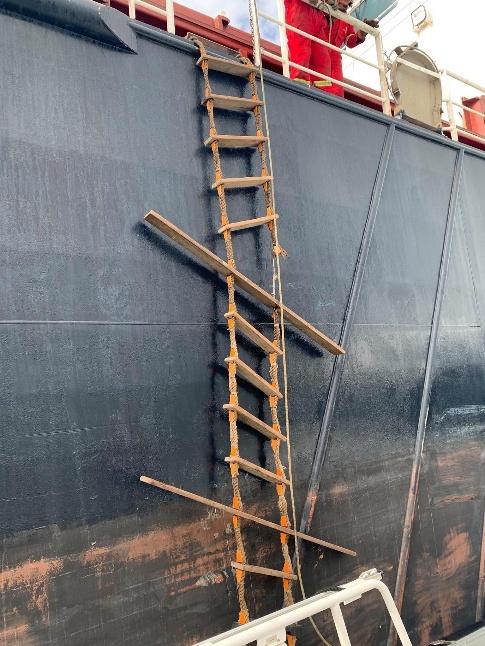
Quite easy to spot the deficiency.
Quite easy to spot the deficiency.
So when the pilot gets hurt using a non-compliant setup, a court may find them partially liable for their own accident. Further down in this article I’ll include some anonymised examples of where this has happened.
Since pilots are considered experts in the field they work in, they are also expected to have in-depth knowledge of pilot transfer arrangements and of the regulations around these transfers. Given the difference between my own tally and the results of the annual IMPA safety campaign, there is a lot to gain here. Pilot associations and individual pilots have the duty and the responsibility to obtain the necessary knowledge. This can easily be implemented in the initial training of apprentice pilots and kept at the required level through continuous personal development.
Deficiencies can be either patent or latent. Patent means they are obvious to spot, in plain sight: broken or loose steps, damaged sideropes, illegal trapdoor systems, incorrect stanchions and what not. Latent flaws can be errors in the rigging, or a ladder that does not meet the required standards — fake ladders. When a pilot uses a ladder with hidden flaws, there is not much to hold against them when things go wrong: the pilot could not have spotted the error, and especially when “the” question has been answered positively, they can climb the ladder in good confidence. No liability towards the pilot.
Since pilots are considered experts in the field they work in, they are also expected to have in-depth knowledge of pilot transfer arrangements and of the regulations around these transfers. Given the difference between my own tally and the results of the annual IMPA safety campaign, there is a lot to gain here. Pilot associations and individual pilots have the duty and the responsibility to obtain the necessary knowledge. This can easily be implemented in the initial training of apprentice pilots and kept at the required level through continuous personal development.
Deficiencies can be either patent or latent. Patent means they are obvious to spot, in plain sight: broken or loose steps, damaged sideropes, illegal trapdoor systems, incorrect stanchions and what not. Latent flaws can be errors in the rigging, or a ladder that does not meet the required standards — fake ladders. When a pilot uses a ladder with hidden flaws, there is not much to hold against them when things go wrong: the pilot could not have spotted the error, and especially when “the” question has been answered positively, they can climb the ladder in good confidence. No liability towards the pilot.
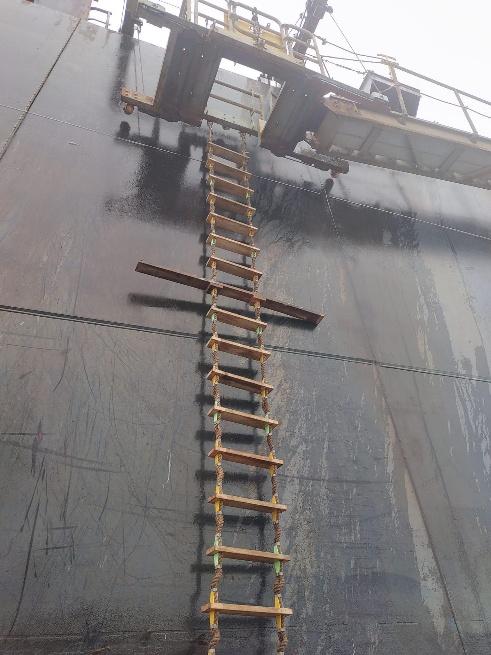
Banned in 1979, still around — as long as we keep climbing dangerous setups, they’ll keep coming.
Banned in 1979, still around — as long as we keep climbing dangerous setups, they’ll keep coming.
When, however, a pilot uses a setup knowing it is non-compliant and therefore dangerous, liability and insurance pay-outs can change overnight. They basically took part of the risk by using a setup they should have rejected and reported. Below I’ll add a few cases where things went wrong.
- In PORT A, a pilot was killed trying to board a vessel at a different location from the official boarding spot. The ladder was hanging loosely in the air close to the stern of the vessel, and the moment the pilot stepped onto it, the launch unexpectedly came up on the 2 m swell and killed the pilot. The court ruled against the pilot for “active negligence”; only after a six-year battle in court was the Administration convicted for a lack of inspection of the means of transfer, and the relatives received compensation.
- In PORT B, a pilot was seriously injured and could not continue his job. Compensation was brought down to 50 per cent because the pilot willingly used a non-compliant arrangement.
- In PORT C, the insurance did not pay out because the pilot had used a non-compliant arrangement, which eventually led to his death.
- In PORT D, a seriously injured pilot sued the shipowners for USD 130,000 to cover medical bills and loss of income. The court ruled that the shipping company was guilty of not rigging a safe arrangement, but the compensation awarded to the pilot was significantly reduced because he had continued to disembark the vessel knowing it was a dangerous setup.
As I said before, the captain is primarily responsible for having a safe and correct system. In PORT E, a pilot had a serious accident: he fell 7 m onto the deck of the pilot launch because the ladder snapped. The investigation proved that this ladder had not been properly stored or checked regularly — something we have added in the new rules, and which is now international law. The vessel was fined USD 32,000 and the captain USD 5,000. In a similar case a year before, a vessel was fined USD 30,500 for being negligent towards pilot transfer safety.
All together, we can state that the implications of a ladder accident are in most cases severe. The chances of getting into an accident are statistically small when you look at the number of boardings and disembarkations worldwide every year. The problem with statistics, however, is that it hurts when it happens to you: most accidents are career-ending, and sometimes even life-ending. And when, after everything that has happened, you are held partly liable for climbing a non-compliant arrangement, it hurts even more.
So please, all be careful out there, and check every ladder before you use it. To ship crews I’d like to say: please take ladders seriously — it’s all we have, and our lives depend on it. Buy only from reputable manufacturers, and stay away from cheap knock-offs with fake certificates.
All together, we can state that the implications of a ladder accident are in most cases severe. The chances of getting into an accident are statistically small when you look at the number of boardings and disembarkations worldwide every year. The problem with statistics, however, is that it hurts when it happens to you: most accidents are career-ending, and sometimes even life-ending. And when, after everything that has happened, you are held partly liable for climbing a non-compliant arrangement, it hurts even more.
So please, all be careful out there, and check every ladder before you use it. To ship crews I’d like to say: please take ladders seriously — it’s all we have, and our lives depend on it. Buy only from reputable manufacturers, and stay away from cheap knock-offs with fake certificates.
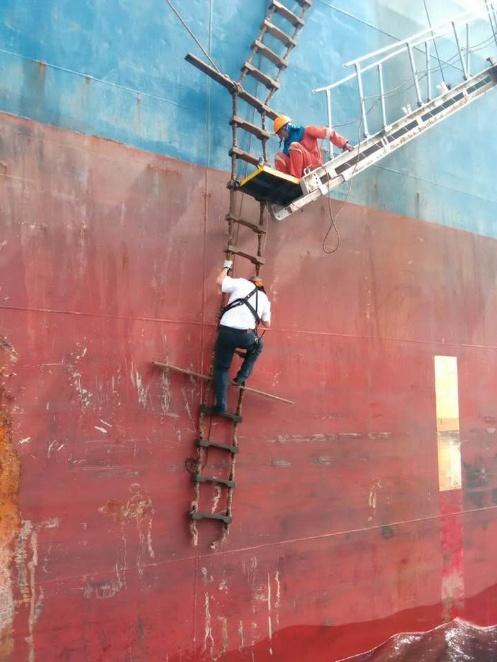
You can always serve as a bad example …
You can always serve as a bad example …
Please stay safe everyone!
Arie Palmers
* * * * *
Arie Palmers is a maritime pilot with Loodswezen in the Netherlands, working the Westerschelde, the Oosterschelde and the adjacent coastal area. He has written on pilot transfer safety for Marine-Pilots.com since 2020 and publishes his weekly tally of non-compliant arrangements as “WEEKLY LADDER MISERY” on social media. His stated aim is zero accidents caused by faulty boarding arrangements.
This article reflects the personal opinion and the own research of the author. It is not legal advice, and it does not represent a position of Marine-Pilots.com or of any organisation the author is associated with. The cases described are anonymised: no vessel, port, company, insurer or person is identified, and the accounts have been generalised so that the lesson stands independently of any local jurisdiction. Readers facing a concrete liability question should seek qualified legal advice.
References: SOLAS chapter V, regulation 23 (as amended); IMO resolution MSC.576(110), Performance standards for pilot transfer arrangements; IMO resolution A.1045(27); IMPA Safety Survey 2025.