Article

New Website PilotladderSafety.com


by Marine-Pilots.com - published on 30 June 2020 300 -

Recently, Herman Broers launched the website PilotladderSafety.com.

This website’s goal is to increase pilot ladder safety by showing good practice examples regarding the rigging and use of pilot ladder arrangements . Do it right the first time!

Directly to the website: www.PilotladderSafety.com

Every day around the world, maritime pilots board and disembark ships using pilot ladder arrangements. When the pilotladder is not used properly, a routine procedure can turn into a critical hazard . Unfortunately we still see a lot of accidents resulting from badly prepared pilot ladders.

Let us use the power of internet to make things better, from a positive point of view. Sharing good practice examples, sharing how it’s done right, the first time .

Every contribution to this website is welcome. If you want more information regarding this initiative, send him a direct message or contact him via info@pilotladdersafety.com.

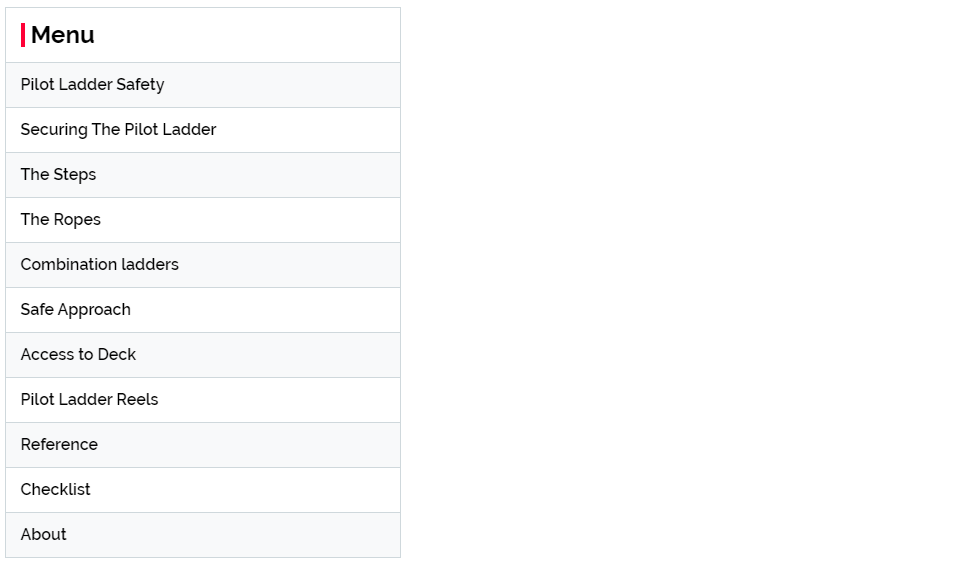
Menu Overview:
Join the conversation...

Login or register to write comments and join the discussion!
René Hartung Lotsenbrüderschaft NOK II Kiel / Lübeck / Flensburg, Germany
on 3 September 2020, 12:02 UTC

Well structured site with a lot of background information - very good initiative.
Keep up the good work for our safety!
0

River Pilot Kris De Decker DAB Loodswezen, Belgium
on 2 September 2020, 07:48 UTC

Great initiative - spread the best practices for ensuring safe pilot ladder arrangements.
0

Read more...

Article #DangerousLadders on Facebook

by Marine-Pilots.com - published on 10 September 2019

A valuable campaign managed by Chris Young, Kevin Vallance and others, which we found on Facebook .

1

Article Origins of the IMPA pilot mark

by Kevin Vallance deep sea pilot and author - published on 24 October 2019

There are many things in both our everyday and professional lives which we take for granted and never question the origins of, an example of this might be the IMPA recommended ‘pilot mark or pilot line’, which is sometimes seen on the side of vessels indicating where a vessels freeboard exceeds 9 metres.

4

Article Pilot Embarkation platforms

by Kevin Vallance deep sea pilot and author - published on 17 December 2019

During the transit time on the pilot launch between the shore and the vessel, marine pilots will spend at least a portion of that time carrying out (either consciously or subconsciously) a risk assessment of the forthcoming operation.

1

Opinion The 2023 review of Pilot Transfer Arrangement Regulations, a chance for innovation?

by Herman Broers - published on 2 January 2023

In the spring of 2023, the IMO Sub-commission on Navigation, Communications and Search and Rescue (NCSR) may start a process of review and amendments to the SOLAS Ch V. reg 23

1

Video Harbor Pilots SRL Career Day

published on 31 January 2021

Captain Bronson Stubbs discusses what harbor pilots do

0

Article GPS (Part 1) - Structure, mode of operation, technical and physical fundamentals of GPS

by Capt. Gunter Schütze, Thailand/Germany - published on 30 January 2020

Of course, as a Nautical Specialist, I also deal with the international discussion on the advantages and disadvantages of satellite-based navigation, e-navigation and conventional terrestrial and astronomical navigation.

0

Article What is a SWASH pilot boat? What's the difference to the SWATH technology?

by Marine-Pilots.com - published on 5 June 2020

At the A&R shipyard in Germany, the successful principle of SWATH boats was further developed in 2013: The SWASH principle allows sea-going, smaller and more economical boats.

0

Article How many Navy vessels are compliant to SOLAS ch.V reg23?

by Arie Palmers - published on 25 April 2022

A 1,000 Navy Vessels around... Quite often those vessels have the tendency of presenting themselves with a pilot transfer arrangement which is non-compliant.

2

Opinion Positioning of vessel at berth by using bridge wing gyro repeater

by Capt. Girish Chandra - published on 14 April 2020

Today I will discuss a very simple and useful practical trick often used by pilots.

When we have to berth a vessel with small clearances forward and aft (say 20 to 25 mtr fwd and aft) it is very essential that you are able to estimate your position. Now most of the time you have a berthing supervisor on jetty who will help you with position.

0

Article Annual Digest 2020 published by CHIRP Maritime

published on 31 March 2021

CHIRP Maritime has published the 2020 Annual Digest. The Digest contains all articles that were published in the quarterly editions of their FEEDBACK magazine.

0