after Iiro Törmä – Novia University of Applied Sciences – Finland
A Finnish research project has concluded that remote pilotage can be built today with components already on the market. Its most difficult problems turned out to be cognitive load, communication discipline and trust. That is the summary of the Remote Pilotage MVP project, funded by Business Finland and completed at the end of 2025. Its findings have now been set out by Iiro Törmä, UX designer and researcher at Novia University of Applied Sciences, in the June 2026 issue of SWZ Maritime. What follows is an abridged version of his article.
In February 2026 the bulk carrier MS Viikki worked her way through ice towards the port of Raahe while colleagues several hundred kilometres to the south followed her from a wall of screens in Turku. They could have conducted the pilotage from shore. They did not — but what stands between could and will is no longer a question of hardware.
That is the summary of the Remote Pilotage MVP project, funded by Business Finland and completed at the end of 2025. Its findings have now been set out by Iiro Törmä, UX designer and researcher at Novia University of Applied Sciences, in the June 2026 issue of SWZ Maritime.
A Finnish research project has concluded that remote pilotage can be built today with components already on the market. Its most difficult problems turned out to be cognitive load, communication discipline and trust. That is the summary of the Remote Pilotage MVP project, funded by Business Finland and completed at the end of 2025. Its findings have now been set out by Iiro Törmä, UX designer and researcher at Novia University of Applied Sciences, in the June 2026 issue of SWZ Maritime. What follows is an abridged version of his article.
In February 2026 the bulk carrier MS Viikki worked her way through ice towards the port of Raahe while colleagues several hundred kilometres to the south followed her from a wall of screens in Turku. They could have conducted the pilotage from shore. They did not — but what stands between could and will is no longer a question of hardware.
That is the summary of the Remote Pilotage MVP project, funded by Business Finland and completed at the end of 2025. Its findings have now been set out by Iiro Törmä, UX designer and researcher at Novia University of Applied Sciences, in the June 2026 issue of SWZ Maritime.
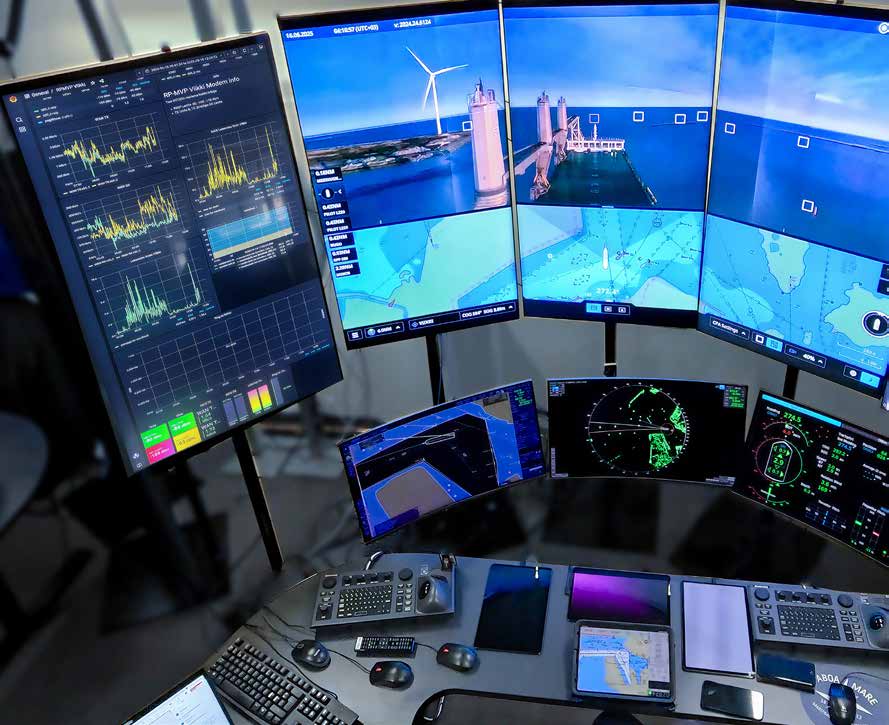
The project's remote operations centre during live operation. The large centre screens carry the Groke Technologies situational awareness view, blending RGB and thermal camera signals; MS Viikki is outbound from Raahe (photo: Iiro Törmä).
The project's remote operations centre during live operation. The large centre screens carry the Groke Technologies situational awareness view, blending RGB and thermal camera signals; MS Viikki is outbound from Raahe (photo: Iiro Törmä).
Safe and affordable — the two conditions
The project was tied to two commitments. The system had to be at least as safe as pilotage conducted from the bridge, carrying the full safety expectation the industry places on a pilot on board. And it had to be affordable — buildable now, from available technology, at a price pilot organisations and shipping companies could realistically meet.Novia University of Applied Sciences led the research. Finnpilot and Fintraffic took part as operational partners, ESL Shipping provided the test vessel, and Furuno, Groke Technologies and Brighthouse Intelligence contributed the technical components. The aim was not a product but a supplier-independent reference model that others could implement within a ten-year horizon.
Composite recording of a conventional pilotage run used as the baseline for the cognitive and behavioural analysis: eye-tracking with the pilot's gaze path, synchronised simulator map view and ceiling cameras from the simulator bridge (photo: Iiro Törmä).
Composite recording of a conventional pilotage run used as the baseline for the cognitive and behavioural analysis: eye-tracking with the pilot's gaze path, synchronised simulator map view and ceiling cameras from the simulator bridge (photo: Iiro Törmä).
Seventeen simulator runs, deliberately made hard
The main body of research was carried out at the Aboa Mare simulator centre in Turku between autumn 2024 and spring 2025: eight conventional pilotage runs as a baseline, six remote runs from a purpose-built remote operations centre, and three exercises on cooperation with the Finnish VTS. Three licensed pilots took turns, each working a fairway they knew well. The bridge teams were deliberately less experienced than the pilot, and pilots and crews did not know one another.The remote runs were designed to be harder than the baseline so that the price of cognitive load would become visible. Instructors injected GPS drift, gyro faults, AIS failures, sudden fog and a steering error that had to be caught from shore. Half of the remote runs gave the pilot no visual feed at all, and rudder angle was unavailable throughout — an unplanned preview of what remote pilotage looks like when an essential feed goes missing. Participants rated these runs among the most demanding piloting of their careers.
The measurements included eye tracking, ceiling video, wireless audio, NASA-TLX workload ratings and structured debriefs.
From discretionary to verified preparation
One shift emerges more clearly than any other. In conventional pilotage, the thoroughness of the master-pilot exchange rests largely with the pilot: the standard is met once the pilot is satisfied it has been. Remote pilotage cannot afford that latitude, because there is no shared bridge to fall back on.Preparation therefore has to be demonstrably complete. Vessel and crew must be confirmed as fit and certified. The passage plan has to be a shared baseline, formally accepted before the operation starts. The steering strategy — autopilot or hand steering — must be agreed for every segment of the fairway. Voice allocation towards the VTS must be settled, and the criteria for suspending the operation defined in advance. And it has to happen the same way every time.
A pilot's own sketch of a minimal conning display for remote pilotage (photo: Jukka Häkkinen).
A pilot's own sketch of a minimal conning display for remote pilotage (photo: Jukka Häkkinen).
What the pilot loses ashore
The principal cost of remote pilotage falls on cognitive workload. Ashore, the pilot loses the implicit channels of being physically present — the glance at the master's posture that confirms an order has landed, the felt response of the vessel to wind and current. Conventional pilotage checks itself continuously through exactly those signals.That information now has to be rebuilt through instruments or spoken exchange, and speech has finite capacity. It competes with VHF traffic, internal bridge conversation and the master's own thinking. Pilots absorb cognitive demand as a matter of professional habit and are reluctant to report overload — which makes the limit hard to see from outside, and easy to cross.
Communication as the central safety factor
The project's final report states plainly that communication plays an outsized role in the safety of remote pilotage. Törmä describes an incident from one run that made the point better than any planned scenario: as an observer he left his laptop microphone open while taking a telephone call, doubling the audio load on a team that was already handling two streams and a series of technical faults. Shared situational awareness collapsed. Nobody in the actual exercise did anything wrong.The conclusion he draws is that designed scenarios are useful, but the failure modes that matter will be unscripted. A number of the project's recommendations are attempts to harden communication against precisely those conditions: closed-loop readback for safety-critical exchanges, channel discipline, a one-voice-to-VTS principle, an adapted master-pilot exchange and minimum manning so that the master does not become saturated.
As one constructive answer, the Novia team developed a briefing tool that lets remote pilot, bridge team and VTS walk through a route together in 2D and 3D before the transit — externalising local knowledge that a pilot would otherwise hold internally and release piece by piece.
Trust does not survive the move ashore by itself
The second thing the system asks for is trust. On the bridge it builds up incrementally and largely without words: a handshake, the master-pilot exchange, the way the officer of the watch answers a heading order, a hesitation, the speed of a readback. Pilot and bridge team read each other continuously, and that relationship quietly does much of the work of keeping the operation safe.Remote pilotage cannot draw on it. Even where video was available, the workflow pushed faces off the screen — participants often used the video link only for the shared map. Under load, according to the project's human factors researcher Jukka Häkkinen, bridge teams tend to settle matters among themselves and inform the pilot afterwards. The runs showed a domestic version of this: master and co-pilot lowering their voices, switching from English to Finnish and back again to address the pilot. Each step is reasonable on its own. Across an hour of dense traffic, they turned the remote pilot from a participant into a voice in a loudspeaker.
ESL Shipping's MS Viikki, a 160-metre bulk carrier, served as the test platform for the technical trials (photo: ESL Shipping).
ESL Shipping's MS Viikki, a 160-metre bulk carrier, served as the test platform for the technical trials (photo: ESL Shipping).
Four tests at sea — and the gap they exposed
The simulator has limits: real connectivity, real cameras and the actual behaviour of a ship require live work. Four tests were run on MS Viikki in the Raahe fairway between June 2025 and February 2026, two of them as formal validations. They were not remote pilotage in the operational sense, but checks that the infrastructure could carry it.The most convincing single component was the situational awareness camera blending RGB and thermal images. In poor light the view from shore was arguably better than the one from the bridge, and voice over the video link stayed stable. But the sea trials revealed something the simulator could not: the gap between an infrastructure that is able to carry remote pilotage and one a pilot can trust to do so. A pilot has to know without hesitating whether their instruments are working — a demand that runs through the entire information architecture, well beyond making individual components function.
The open question: what kind of working life?
The technical path is visible; the harder work is sociotechnical. Training for remote pilots, and equally for the masters and officers who will work with them. Communication discipline, which under pressure is a craft rather than a checklist. Clear definitions of when to suspend or abort, and pre-agreed safe states that make those decisions clean.And one question the project has not answered, which Törmä names as his own favourite among the open ones: what kind of working life does remote pilotage actually offer? What does a remote pilot's week, year and career look like? How is occupational stress managed across decades of a screen-based job that still carries the full moral weight of pilotage?
The project treats remote pilotage as a family of modes — fully remote, remote support as a second pilot, and hybrid arrangements with a handover mid-transit between a pilot on the bridge and one ashore. Both systems will operate side by side within one service. Making that service ordinary — safe, dependable and survivable for the people who will do it — is the work that now begins.
Stakeholder workshop during the project. From left: Juha Rokka (Groke Technologies), Esa Kallio (Fintraffic) and Finnpilot remote pilots Joakim Kantola, Ville Mattila and Timo Nummi (photo: Iiro Törmä).
Stakeholder workshop during the project. From left: Juha Rokka (Groke Technologies), Esa Kallio (Fintraffic) and Finnpilot remote pilots Joakim Kantola, Ville Mattila and Timo Nummi (photo: Iiro Törmä).
The recommendations at a glance
- Training and certification. A distinct competence standard and certification track for remote pilots; certification of vessels based on technical readiness and required onboard equipment; eligibility requirements for masters and crews based on seagoing experience and familiarity with remote pilotage.
- Technology. Redundant connectivity; visibility of bandwidth use for the pilot and the ability to switch off subsystems under strain; forward camera view, radar, conning and chart displays with status and latency indication; an accessible logging system.
- Preliminary arrangements. Restrict the service to fairways of manageable complexity; confirm vessel, crew and system eligibility before every operation.
- Preparation. Complete the master-pilot exchange beforehand and treat it as a formally accepted shared baseline; agree steering strategy per segment, voice allocation and abort triggers in advance; run a pre-start technical check confirming that the shore indications match the ship's behaviour within the expected latency.
- Coordination with VTS. Remote pilotage does not alter the responsibilities of the VTS; apply one voice to VTS per leg and make any handover of that voice explicit and timed.
- Navigation and communication. Closed-loop readback for safety-critical exchanges; channel discipline against overlapping audio; minimum manning to avoid cognitive overload of the crew.
SOURCE
This report is based on the article "The harder half of remote pilotage — a designer's notes from a Finnish research project on shore-based pilotage" by Iiro Törmä, published in SWZ Maritime, June 2026, pages 66–70.Iiro Törmä, MA, is a UX/UI designer and researcher at the Faculty of Technology and Seafaring, Novia University of Applied Sciences, Finland.