Article

New Website PilotladderSafety.com


by Marine-Pilots.com - published on 30 June 2020 300 -

Recently, Herman Broers launched the website PilotladderSafety.com.

This website’s goal is to increase pilot ladder safety by showing good practice examples regarding the rigging and use of pilot ladder arrangements . Do it right the first time!

Directly to the website: www.PilotladderSafety.com

Every day around the world, maritime pilots board and disembark ships using pilot ladder arrangements. When the pilotladder is not used properly, a routine procedure can turn into a critical hazard . Unfortunately we still see a lot of accidents resulting from badly prepared pilot ladders.

Let us use the power of internet to make things better, from a positive point of view. Sharing good practice examples, sharing how it’s done right, the first time .

Every contribution to this website is welcome. If you want more information regarding this initiative, send him a direct message or contact him via info@pilotladdersafety.com.

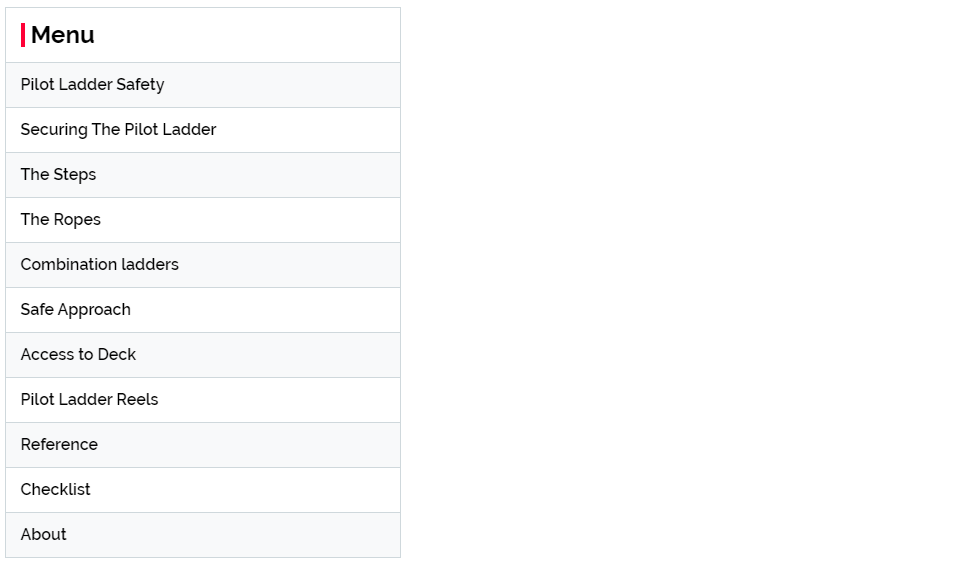
Menu Overview:
Join the conversation...

Login or register to write comments and join the discussion!
René Hartung Lotsenbrüderschaft NOK II Kiel / Lübeck / Flensburg, Germany
on 3 September 2020, 12:02 UTC

Well structured site with a lot of background information - very good initiative.
Keep up the good work for our safety!
0

River Pilot Kris De Decker DAB Loodswezen, Belgium
on 2 September 2020, 07:48 UTC

Great initiative - spread the best practices for ensuring safe pilot ladder arrangements.
0

Read more...

Article #DangerousLadders on Facebook

by Marine-Pilots.com - published on 10 September 2019

A valuable campaign managed by Chris Young, Kevin Vallance and others, which we found on Facebook .

1

Article Origins of the IMPA pilot mark

by Kevin Vallance deep sea pilot and author - published on 24 October 2019

There are many things in both our everyday and professional lives which we take for granted and never question the origins of, an example of this might be the IMPA recommended ‘pilot mark or pilot line’, which is sometimes seen on the side of vessels indicating where a vessels freeboard exceeds 9 metres.

4

Article Pilot Embarkation platforms

by Kevin Vallance deep sea pilot and author - published on 17 December 2019

During the transit time on the pilot launch between the shore and the vessel, marine pilots will spend at least a portion of that time carrying out (either consciously or subconsciously) a risk assessment of the forthcoming operation.

1

Article The NZMPA Good Practice Guide for Pilots 2021

published on 4 April 2022

The Good Practice Guide for Pilots 2021 describes the knowledge and skills (technical and non-technical) that the NZMPA believe all pilots should aim to achieve and maintain. It is written primarily for pilots for their own guidance and professional development, but can be used as a framework for pilot training, proficiency and assessment. It is referenced to NZ Maritime Law and Codes.

1

Video Zig-Zag-Test-Manoeuvre for Yaw Stability, IMO Manoeuvring Standards and Crash Stop

published on 26 November 2021

Another valuable explanatory video by Knud Benedict:
Zig-Zag-Test-Manoeuvre for Yaw Stability, IMO Manoeuvring Standards and Crash Stop

0

Video Maritime Pilot Training V - Pilot Ladder Training

published on 12 May 2021

Training video V on the correct use of the pilot ladder

0

Article Report: Securing of pilot ladders at intermediate lengths – testing

by nc2 Engineering Consultancy - University of Southhampton - published on 28 July 2023

Report by nC2 Engineering Consultancy at the University of Southampton on behalf of the International Maritime Pilots' Association (IMPA) to investigate the effectiveness and impact of different methods of securing pilot ladders in medium lengths in a laboratory-based project.

0

Video Understanding and Preventing Tug & Barge Risks

published on 15 January 2021

Blog: https://www.merrimacins.com/understanding-and-preventing-tug-barge-risks/ Understanding and Preventing Tug & Barge Risks The maritime industry relies on tugboats and barges for a wide range of applications. Tugs are used to pilot vessels into and out of ports, while barges are used to transport bulk materials. The relationship between tugs and barges is critical, as most barges are not self-propelled and must rely on the skilled operation of a tug or tugs for propulsion. At Merrimac...

0

Article Dissertation: Reducing the subjective impact in maritime simulator assessment (2020)

published on 14 October 2021

"A performance assessment tool for maritime pilotage operations" - by Jørgen Ernstsen, Norway
When the ship is approaching or leaving a port, a local navigational expert, the pilot, is often provided for assisting the bridge team to safely and efficiently navigate the littoral waters.

0

Video Maritime Pilotage at Tanger Med Port - APL Lion City, 398m

published on 2 September 2020

Pilotage job at Tanger Med Port. Sailing of APL Lion City from Eurogate Terminal. She is lengthened to 398 m LOA , and increased her capacity to 17,300 TEU.

0